


How to Write a Website or Software Brief That Gets Accurate Quotes
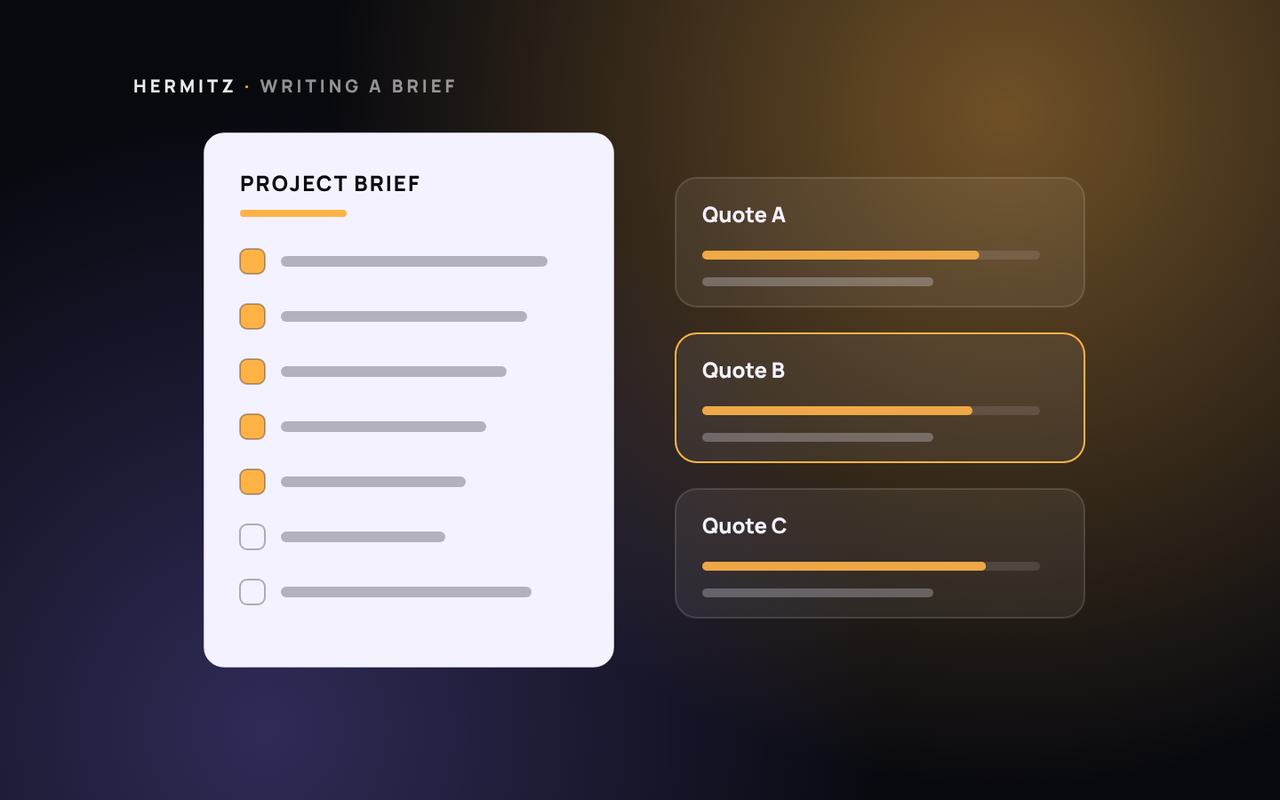
Vague briefs get vague quotes that are impossible to compare. A clear two-page brief gets you accurate proposals faster. Here is a template you can use today.
/ Table of contents:
- 1. Background
- 2. Goals
- 3. Users
- 4. Scope
- 5. Integrations and data
- 6. Content
- 7. Technical and legal requirements
- 8. Timeline and budget
- 9. What you want in the proposal
- 10. How you will decide
- Comparing proposals fairly
- A one-page brief template
- Common mistakes in briefs
- After you choose a supplier
- Send us your brief
If you send "we need a new website, how much?" to five agencies, you will get five prices that cannot be compared, because each agency imagines a different project. A good brief fixes that. It does not need to be long, just specific.
1. Background
Two or three sentences on your business, your customers and why you are starting this project now.
2. Goals
What should the project achieve? Be measurable where possible:
- more enquiries or bookings;
- less manual work for a specific team;
- launching in a new market or language;
- replacing a system that is failing.
3. Users
Who will use it: customers, staff, partners, administrators? What do they need to do?
4. Scope
List the main pages or features, and mark each as must have, should have or nice to have. For a website, note the number of pages, languages and special sections such as listings, bookings or a shop. For software, list the main workflows and user roles.
5. Integrations and data
Which systems must it connect to: CRM, ERP, accounting, payment gateway, WhatsApp, maps? Is there existing data to migrate?
6. Content
Who will provide text, photos and videos? Do you need copywriting, Arabic translation or photography?
7. Technical and legal requirements
Hosting preferences, security needs, accessibility, data protection requirements and anything your industry regulator expects.
8. Timeline and budget
Give your target launch date and any fixed deadlines. Share a budget range. It helps agencies propose the right solution instead of guessing.
9. What you want in the proposal
- approach and phases;
- team and who your contact will be;
- timeline with milestones;
- price, payment terms and what is excluded;
- support after launch;
- relevant examples of similar work.
10. How you will decide
Tell bidders your evaluation criteria and the date you will decide. You will get more thoughtful proposals.
Comparing proposals fairly
Put proposals side by side against your must-haves. Ask about anything unclear, and be cautious of very low quotes that skip discovery, testing or support. For software projects, our guide to choosing a software development company in Dubai lists the questions to ask.
A one-page brief template
If you only have time for one page, answer these questions:
- Who are we? One sentence about your business.
- What do we need? One sentence about the project.
- Why now? The problem or opportunity behind it.
- For whom? The main users.
- Must-haves: five to ten bullet points.
- Connections: systems it must work with.
- Deadline and budget range.
- Contact person and decision date.
Attach examples of websites or tools you like, and say what you like about them.
Common mistakes in briefs
- Listing features without explaining the goal behind them.
- Asking for a fixed price without sharing scope or budget.
- Hiding important constraints, such as a hard launch date or an existing system that must stay.
- Sending the brief to too many suppliers, which reduces the effort each one puts in.
- Choosing on price alone, without comparing approach, team and support.
After you choose a supplier
Turn the brief and the winning proposal into a written agreement with scope, milestones, acceptance criteria, ownership of code and content, and support terms. Keep the brief as the reference point when questions about scope come up later.
Send us your brief
Use our request for quotation form to send a formal RFQ with documents and a deadline, or start a project with a short brief.
Frequently asked questions
Should we share our budget in the brief?
Yes, a range is enough. It helps agencies propose a solution that fits instead of guessing, and makes proposals easier to compare.
What is the difference between an RFQ and an RFP?
An RFQ asks mainly for prices against a defined scope, while an RFP asks suppliers to propose an approach as well as a price. Many website and software briefs combine both.
Newsletter
Get new articles by email
Occasional articles on websites, software, AI and search, from our team in Dubai. About once a month, no spam.
Keep reading
More insights
Partner programme
Earn money by referring clients
Know a business that needs a website, software, an app, SEO or AI? Introduce them to Hermitz and earn commission when they pay. Commission up to 15%.